
The Right Texture
On softness, urgency, and learning when not to fix

May you choose environments that bring out the softness in you, instead of the survival in you.
I’ve been carrying this line around for about a week now. It came up in my insta feed and it keeps tapping me on the shoulder at odd moments, not loudly, just enough to make me pause and wonder what my tone sounds like from the outside.
When I’m trying to help someone, pointing something out, steering them toward what I think might be healthier, it feels loving to me in the moment. At the same time, there’s often a quiet why can’t they see what I see underneath it, and that’s where the edges creep in. The way it lands can be braced. A little sharp around the edges. I don’t set out to sound that way. It just happens, and then later I realize, oh. That was me again. I didn’t catch it in time.
I’m good at reading conditions. I’ve always been good at that. I can sense when something isn’t flowing, when there’s resistance, when things could be easier. What I’m less good at is knowing when to leave those conditions alone. I’m realizing I bring the same impulse to people that I bring to snow. If it’s not working smoothly, my instinct is to adjust it.
Since moving to the farm, I’ve come to love winter. The sound of it. The chickadees, the blue jays, the cardinals,
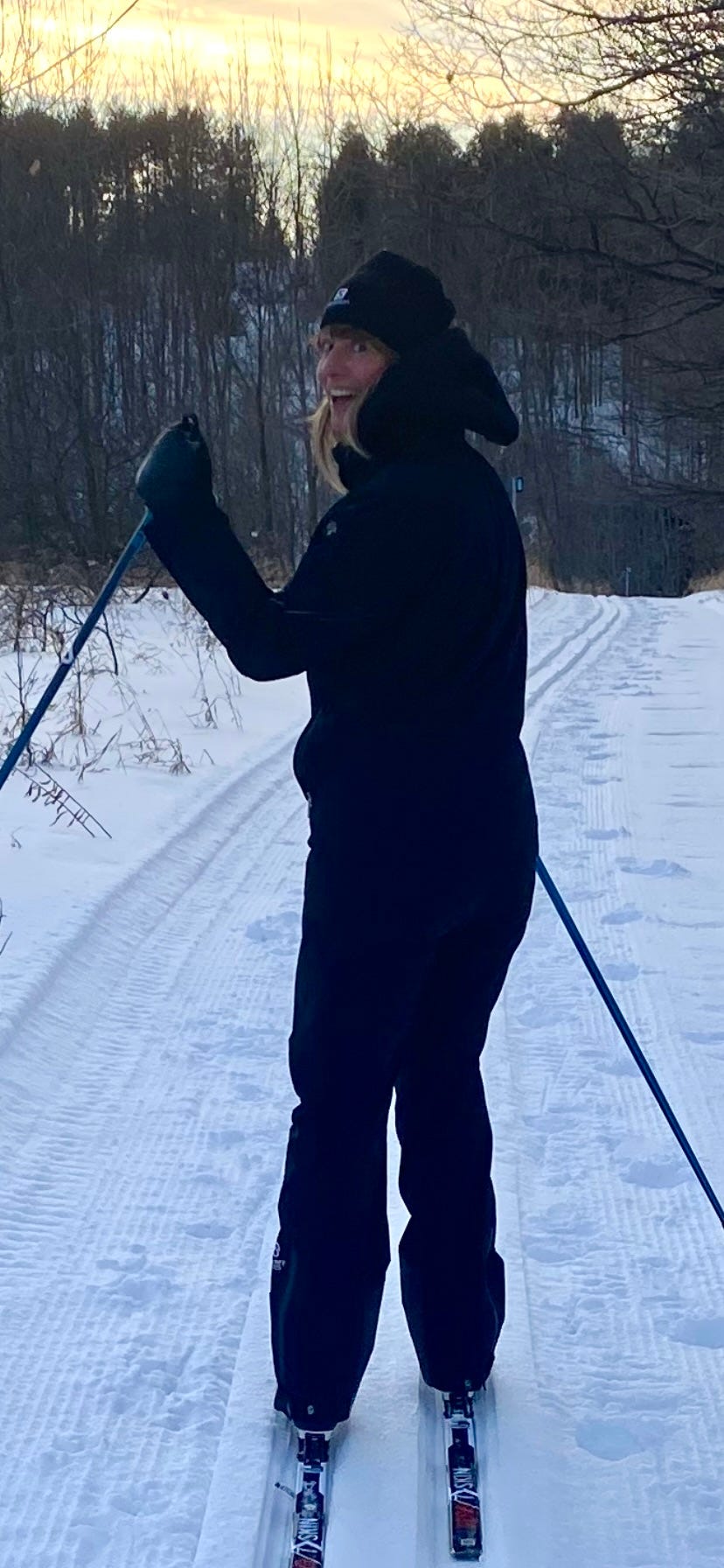
and my favourite, the ravens. The ones that stick around for the cold and bear down rather than flap south to warmer climates. The way snow piles up and quiets everything down. I don’t even mind the shovelling, carving narrow walkways between the Airstreams, from studio to woodshop, making small paths of order through the mess. Cross country skiing has become part exercise, part meditation, part daily reset. And snow does something very predictable to my brain. It flips a switch. How do we make this better. Easier. Smoother.
Last year I built a track setter after watching a YouTube video, genuinely excited to carve out perfect trails to glide through, until the dogs walked all over them and made a mess within hours. I laughed, but I also immediately started thinking about solutions. Maybe we need a Ski Doo. Maybe I need to rethink the whole system. The winter before that was so deep that nothing worked the way it was supposed to. Machines failed. Tracks were always just a little wrong. Snow has a way of inviting correction. Or maybe it just invites me to correct it.
And I don’t always notice when that low grade buzz of making things better starts rearranging things that aren’t mine.
I know this because my dog Jersey used to react to it long before I had language for it. I could be animated in an ordinary conversation, excited about something I cared about, and she’d come over and climb straight into my lap, all concern, trying to calm me down. She mistook my urgency for anger.
At the time, I would say, it’s okay girl, I’m not mad, I’m just excited. But now I see it differently. She wasn’t responding to my intention. She was responding to what my body was broadcasting to the room. That’s been sitting with me.
In A New Earth, one of the books that changed me and helped me see more clearly how my communication can miss the mark, Eckhart Tolle talks about how the pain body feeds on intensity. I recognize that buzz. It can feel like purpose when it’s really activation. He writes, “The pain body wants to survive, not to be healed.” That line stopped me. I have relationships in my life that feed my pain body, and I don’t want that feeling anymore. I want to heal it, not keep it alive. And in Codependent No More, Melody Beattie, one of the books Lisa and I listened to on one of our tours a few years back, describes how fixing can become a way of regulating ourselves. Helping, adjusting, intervening, it can calm me, even when it isn’t what the moment actually needs. I don’t love admitting that. But I can feel when it’s true.
Saturday, the snow was awful for skiing. Heavy. Wet. Grabby. It was a slog. Zero glide. Pushing and panting, getting nowhere. Heart rate high, dignity low. When we finally stopped and flipped our skis over, the bottoms were caked inches thick. Glide not.
I felt my body react. My shoulders crept up without me noticing. My jaw clenched. My breath got shallow, lungs tightening like they were gearing up for impact rather than movement. There was that familiar internal friction, nerves rubbing against my blood. I felt the urge to force my way through it. To push harder. To fix the conditions instead of staying with how uncomfortable I felt.
Sunday was different.
The temperature dropped. The snow settled. The conditions held. Firm base, a light dry layer on top. This is the right texture of snow! So easy to stop thinking and just move.
We’re lucky to have some beautifully groomed trails not far from us, kept up by someone who simply loves doing this and lets people ski there for free. Everything eased. My shoulders dropped. The noise inside my body quieted. Hours of what felt like flying, locked into machine-set parallel grooves. Nothing catching. Nothing asking for correction.
And somewhere in that ease, I noticed something else. Without the friction, without my body bracing or scanning for what needed fixing, my mind went quiet too. I wasn’t organizing or improving or getting ahead of anything. I was just moving.
That’s when it hit me how different I am when nothing in me feels under threat. How care doesn’t rush forward then. How it doesn’t need to steer. I
could still care deeply. I just wasn’t trying to manage everything at the same time.
That contrast keeps looping back through me.
When I’m in environments, emotional or otherwise, that require constant vigilance or correction, something in me tightens. Survival takes the wheel. Love turns directive. Even when I’m right, something essential can get lost. I don’t want to be harsh. I don’t think most of the time I even realize I am. I want to learn how to notice sooner. How to stay softer longer. How to let care arrive without armor.
I don’t think softness is about being passive. I think it’s about timing. About knowing when to intervene and when not to. About letting things move without being shaped by me.
Today the snow is good. I know the temperature will change that. Conditions always do. I don’t get to control them, only how I meet them. And I’m still practicing what that looks like.
The way you framed wanting to make the snow into something that it would never be until it became something different was an absolutely beautiful insight. In the end, we can only control ourselves, not only when we’re ski skiing, but in the rest of life. Really enjoyed this passage . 🫶🏼
Maybe you need a pair of K-Tel Super Slider Sno-skates? Ha. It's always fun to slide in behind your thoughts here, Brenley! Fun fact: Did you know that a group of chickadees is called a "banditry"? Given your love affair for ravens, you must read Bird Brains: The Intelligence of Crows, Ravens, Magpies, and Jays by Candace Savage.
Just heading out for a snowshoe tromp in our woods to see who left tracks before us in the night.